

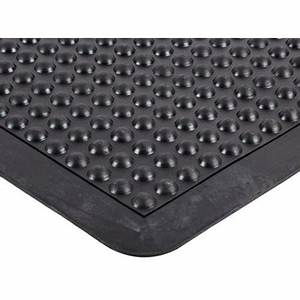
Long shifts on hard floors are part of retail, salon and hospitality work: the till, the styling chair, the pass, the bar and the reception desk all keep people standing in a surprisingly small patch. Well-placed anti-fatigue mats are designed to make that standing more comfortable by introducing a slight, stable give underfoot. They are not medical devices and they will not make a poorly organised shift easy, but placed in the right spots they are one of the simpler workplace comfort upgrades a manager can make.
This guide is for small shops, salons, cafes and similar independent businesses. It is practical advice, not a full occupational health assessment.
Where mats help most
Map the floor by watching where people actually stand still, not where the furniture catalogue says they should stand.
Typical high-value positions include:
- Tills and wrap counters
- Reception and booking desks
- Behind a bar or coffee machine
- Beside salon chairs and basins, if water can be managed
- At a kitchen pass or plating table in a small cafe
- Packing or click-and-collect benches
A mat in the middle of a walking aisle is usually a trip. A mat that covers the true standing zone, and stays there, is the one staff will thank you for.
In back-of-house food prep for a small cafe, compare standing comfort products with washable kitchen floor mats and choose a surface you can clean to the standard your food business requires.
What to look for
Comfort. The mat should have some resilience without feeling unstable. If someone feels they are balancing on a sponge, the mat is too soft for all-day work.
Stability. Edges should lie flat. A curled corner beside a till is a claim waiting to happen. On smooth shop vinyl or tile, the underside must not skate as people turn.
Cleaning. Retail and hospitality dirt is specific: drinks, hair, product spills, cardboard dust. Choose a surface that can be wiped or scrubbed with the cleaners you already use, and that will dry before the next service.
Profile. A low, visible edge is usually safer in customer-facing areas than a thick, dark lip that visitors do not expect. Behind a closed counter, you may have more freedom.
If you are comparing anti fatigue rubber mats for a counter position, look at how staff turn as much as how they stand. A slightly larger rectangle can be better than a small circle that everyone perches on one edge of.
Wet areas, salons and bars
Water changes the job. At a salon basin or a bar well, a mat must cope with splashes and still offer reasonable grip. It should not become a permanently soggy pad. Look for a surface that can drain or be lifted to dry, and keep electricals in mind around basins and coffee machines.
No mat makes a wet, freshly mopped tile completely safe. Clean spills promptly and treat a wet mat as you would a wet floor: a reason to slow down, not a reason to stop paying attention.
Hair is a particular salon problem. It wraps around texture and the underside of a mat. Daily lifting and cleaning at basin positions is part of making the product work.
Behind longer service runs, some businesses prefer a continuous runner. Some managers use ribbed rubber flooring rolls, which can be useful for creating a defined, wipeable strip along a counter, provided the ribs run in a way that helps water and cleaning rather than trapping dirt against a wall.
Fitting without creating new hazards
Loose-laid mats are easier to clean and to move when you rearrange a till. They must be heavy enough, or backed appropriately, to stay put. If you tape or bond anything, use a method compatible with the floor finish — especially on rental vinyl you will one day have to return — and keep edges flat.
Do not cover floor sockets in a way that invites liquid towards them. Do not block a flight path that fire risk assessments treat as an escape route with a heap of overlapping mats.
In stockrooms, compare customer-facing mats with tougher factory floor mats if staff are packing boxes rather than serving. The standing problem is similar; the dirt and trolley traffic are not.
Measure the true stance. Two people sharing a pass need more width than one person at a card machine.
Cleaning and rotation
Build mats into the close-down, not into a once-a-term deep clean:
- Pick up debris, including hair and cardboard fragments.
- Wipe or wash with a milder cleaner first, using something stronger only if the manufacturer and your COSHH notes allow it.
- Rinse residue; leftover detergent is slippery.
- Dry the mat and the floor beneath before you put it back.
- Check edges and replace any piece that has curled, split or polished smooth.
Having a spare mat for a key position means you can dry one while the other is in service. Other anti-fatigue mats in staff areas — a back kitchen or ironing corner — should be cleaned to the same rhythm or they become the forgotten sour patch.
What mats cannot do
They cannot replace seating where seating is appropriate, or rest breaks, or a review of rostering. They cannot correct a sloping, broken floor. They should not be treated as personal protective equipment unless a specific product is offered and assessed for that role.
Comfort is also personal. Offer a sensible mat at the standing points and listen if someone finds a particular thickness awkward.
Common mistakes
- Putting a tiny mat under one foot at a wide counter
- Leaving a curled edge on the customer side of a till
- Using a deep workshop scraper surface that is miserable to stand on for eight hours
- Never lifting salon mats, then wondering where the smell comes from
- Buying on thickness alone without thinking about cleaning
Place anti-fatigue mats where people stand still, choose a surface you can clean during service and at close-down, and keep the edges flat. That is a small, practical improvement for shops, salons and hospitality teams, and it works best when it is part of how the floor is managed rather than a forgotten extra under the till.