

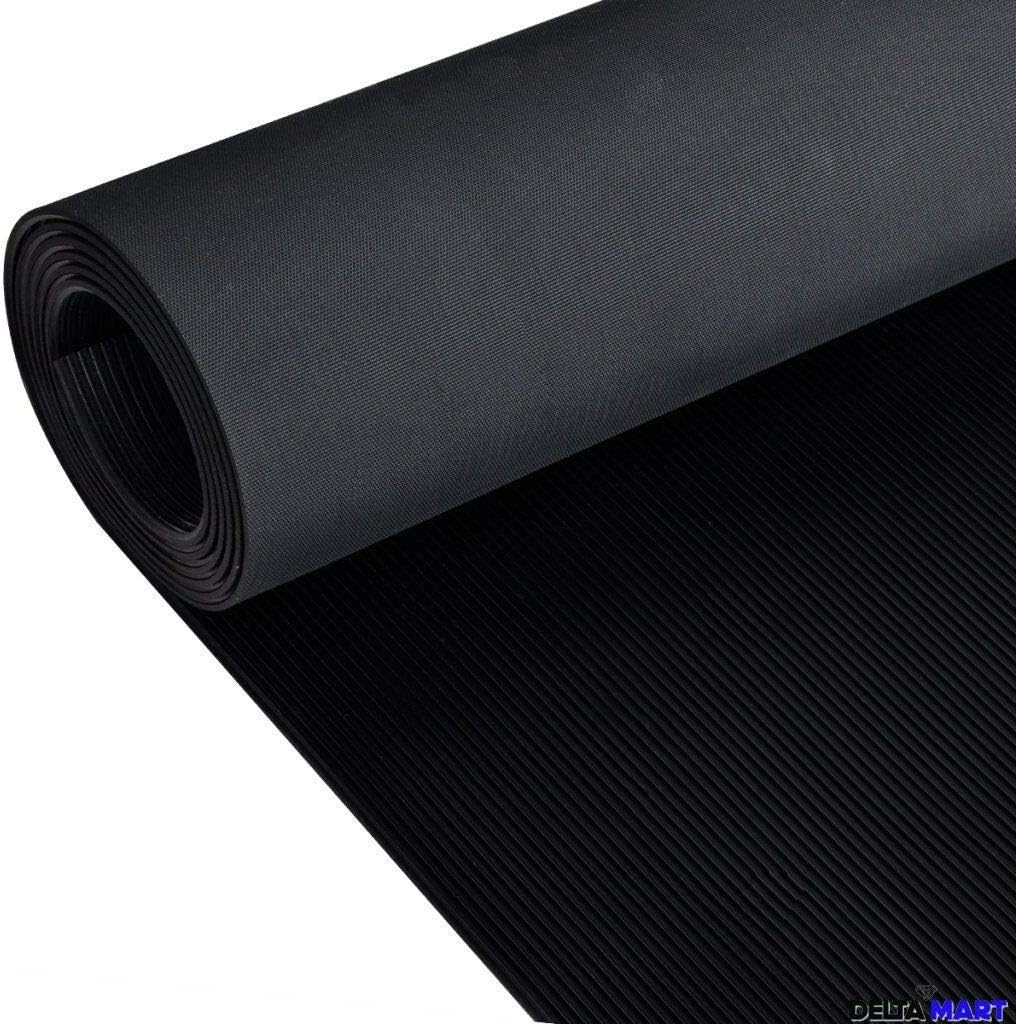
Some rooms and vehicles do not need a grid of tiles or a single heavy mat. They need a continuous, wipeable run that can follow a corridor, a van floor or the strip in front of a washing machine. That is where ribbed rubber flooring rolls earn a place. The fine rib pattern helps water and dirt travel along the grooves, gives a bit more grip than a completely smooth sheet, and looks neater in a long, narrow space than a patchwork of offcuts.
This guide is for households, van owners and light utility spaces. It is not a specification for a commercial kitchen or a public wet room.
What the rib pattern is for
Ribs do two useful jobs. They add texture underfoot, and they create channels that encourage water to move rather than sit as a film. How well that works depends on the direction you lay the ribs, the fall of the floor and how often you clean the grooves.
Laid with the ribs running towards a door or drain, a ribbed roll can help wet footprints dry more quickly than a flat mat. Laid so the ribs form little dams against a wall, the same product can hold dirty water in stripes. The pattern is a tool; orientation matters.
Ribbed rolls are usually thinner than chunky gym tiles. That is an advantage over thresholds and in vans, where extra height quickly becomes a nuisance. It also means they are not a substitute for a thick lifting platform or for independently assessed safety surfacing.
If you need a broader choice of widths and compounds, compare general rubber flooring rolls as well as fine-rib options.
Homes: utilities, side entrances and worktops of the floor
Good domestic uses include:
- The strip in a utility room in front of the washer and sink
- A back-door run where boots are taken off
- A basement or cellar staircase landing that sees damp footprints
- A workshop-in-a-shed bench area where you want a wipeable floor, not a gym
Measure the clear width between kitchen units or walls and check whether a standard roll width will save you a long joining seam. Leave space for appliance doors to open. Do not run a thick edge into a dishwasher door arc.
In a hallway, a ribbed runner can protect boards from wet school bags, but vacuum the grooves or they become dark lines of grit. At a side entrance the roll can meet a proper door mat so the worst mud never reaches the ribs.
Other ribbed rubber flooring rolls are worth looking at if you need a slightly different width or length to reduce joins in a galley utility.
Vans and similar vehicles
A van floor sees grit, toolboxes and wet loading. A ribbed roll cut to the load space gives a surface you can sweep and hose more easily than bare painted metal, and it can reduce some sliding of lighter boxes. It will not stop a heavy unsecured load moving; that is still a securing job.
Measure around wheel arches, lashing points and any fixing you must keep accessible. Make a paper template for the awkward parts. Cut so that ribs run towards the doors if you want water to travel out when you hose the floor.
Fixing must suit the vehicle and the product. A covering that lifts at the leading edge will catch a crate and tear. Follow any guidance about adhesive or mechanical fixings, and do not cover ventilation or important access panels.
If you prefer a plain sheet in the same role, look at roll ranges rather than forcing gym tiles into a van. Tiles leave a grid of joints that collect dirt in a moving vehicle.
Broader rubber flooring rolls can be compared when the van also needs a more closed surface under a bulkhead or cabinet.
Laying and cutting indoors
Acclimatise the roll in the room so it relaxes. Sweep the floor; grit under a thin roll telegraphs through and scratches the finish beneath.
Dry-roll the length and let it sit before you cut the final end. Mark rib direction first. Use a sharp blade, a straight edge and several passes. Keep the factory edge at the most visible side where you can.
Whether you loose-lay or bond depends on traffic and the manufacturer's advice. Loose-laying is easier in a utility you may reconfigure; the roll must then be heavy enough, or tucked carefully, not to ruck at the doorway. If you use adhesive, keep it off the visible ribs and do not trap a damp floor underneath.
Stairs are a specialist case. Do not treat a leftover strip as stair covering unless the product and the nosings are suitable; a moving runner on a stair is dangerous.
Matching ribbed rubber flooring rolls from another range should still be checked for thickness so a doorway threshold does not become a step between two different products.
Cleaning the grooves
The ribs only work if you clean them. Sweep or vacuum along the grooves, not just across them. Mop with a mild cleaner, rinse residue, and dry walking routes before they are used in socks. On a van floor, empty the vehicle occasionally and hose it, then leave the doors open so the covering can dry.
Avoid oily dressings that make the ribs shiny. A glazed rib is just a series of small slippery ridges.
When a section wears through in a doorway, it is often easier to replace a length of roll than to live with a hole that collects water. Keeping a leftover piece from the original batch helps.
General rubber flooring rolls follow the same care logic even when the surface is smoother: grit off first, mild wash, dry thoroughly.
Common mistakes
- Laying ribs so they dam water against a wall
- Using a thin ribbed roll as gym flooring for dropped weights
- Leaving unsecured material on stairs
- Never cleaning the grooves and deciding "ribs don't work"
- Joining two different thicknesses at a doorway without a proper transition
Ribbed rubber flooring rolls are at their best in long, wipeable spaces: utilities, side entrances and van floors. Point the ribs where you want water to go, cut carefully around the obstacles you actually have, and keep the grooves clean so the pattern can do its job.