

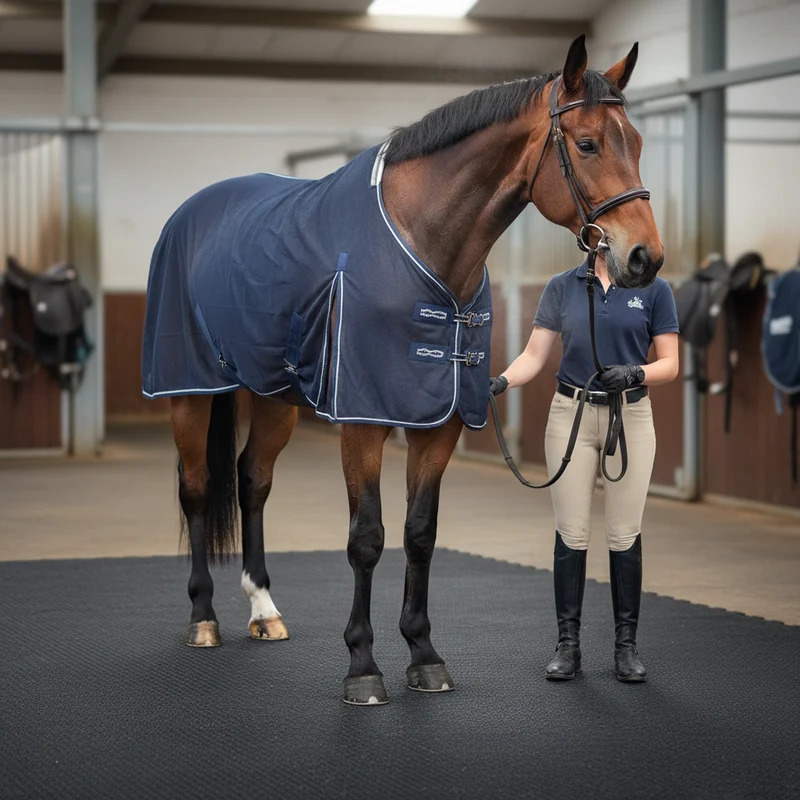
Where does the mud start on your yard? For most owners on DIY livery or a smallholding, it is not the stable. It is the field shelter, the patch by the water trough and, above all, the gateway that every horse uses twice a day. Rubber horse mats are usually thought of as stable flooring, but some of their most useful work happens outside.
Here is how to use them in the places that get churned up first.
Why field shelters and gateways poach so badly in winter
Poaching happens when hooves repeatedly break up saturated ground. Every step pushes into soft soil, mixing it with water until grass gives way to deep mud.
Gateways suffer because horses congregate there, waiting to come in or turning around as they are led through. Field shelters suffer because horses stand in the same spot for long periods, often at the entrance where rain blows in. Troughs and hay feeders are similar hotspots. Once the turf has gone, the mud gets deeper with every wet day, and by February it can be ankle deep in places.
The aim of matting is to give these concentrated areas a firm surface that spreads the load and stops hooves breaking through.
Mud is not just an inconvenience. Standing in wet, churned ground for long periods can soften hooves and leave legs caked, and many owners find that mud-related skin problems are harder to manage when horses cannot get out of the wet. A firm, clean area at the gate and the shelter gives horses somewhere drier to stand and makes leading in and out safer for you too.
Matting a field shelter floor
A field shelter floor takes a lot of standing traffic, droppings and moisture. Laying rubber horse mats over a prepared base gives a firm, cleaner floor that is easier to muck out and more comfortable to stand on than compacted earth.
Start by removing any soft, muddy material and levelling the floor. A compacted hardcore base, ideally with a slight fall towards the open side, gives the mats something firm to sit on. Lay mats tightly together across the whole floor and extend them a little beyond the opening, where horses step in and out.
Some owners add a thin layer of bedding on top in winter, which helps absorb urine and gives horses somewhere comfortable to lie.
Wash bays: grip and drainage for wet hooves
Wash bays combine water, soap and a horse that may not be thrilled about being hosed. Grip is everything. The floor must stay reliably non-slip when soaking wet, and water must drain away quickly.
Look for mats with a textured surface and consider how water will escape, either through drainage holes or across the surface to a drain. Make sure the base falls towards that drain so water does not pool under the mats. For extra flexibility, Delta Rubber Imports has a range of horse mats that may suit wash bays as well as stables.
Rinse the mats regularly so soap residue and mud do not build up and reduce grip. If your wash bay doubles as a tie-up or shoeing area, think about where the farrier will work and keep that patch especially level.
Gateways and tracks: mats vs grass mesh
For gateways, there are two main approaches. Heavy ground protection mats create a solid, firm surface that copes with intense hoof traffic. They work well in very wet gateways where the ground is already badly poached.
grass protection mesh takes a different approach. Laid over existing grass, it reinforces the turf while letting grass grow through. It suits areas that are getting worn but have not yet turned to mud, and paths or tracks where you want to keep a green look.
In practice, many yards use both: solid mats at the gateway itself, and mesh on the tracks leading to it. For a comparison, Delta Rubber Imports lists grass protection mats designed for grass reinforcement.
Fixing outdoor rubber horse mats so they stay put
Outdoor mats face weather, frost and hooves pulling at their edges, so fixing matters more than it does indoors. Prepare a firm, level base, ideally compacted hardcore or a similar sub-base, so mats cannot rock.
Join mats tightly together, and pin or anchor edges according to the manufacturer’s guidance. Where mats meet grass or soil, finish the edge so it is flush, with no lip for hooves to catch. Check fixings after heavy rain or frost, which can loosen the ground around pins.
For areas outside the stable block, rubber exterior mats from Delta Rubber Imports are another option if you need to cover a larger area.
Seasonal maintenance checklist
A little regular attention keeps outdoor matting working for longer:
- Autumn: clear leaves, check fixings and repair base dips before the wet sets in
- Winter: scrape off mud and droppings regularly and watch for lifting edges
- Spring: lift a mat or two to check the base, reseed bare patches around mesh
- Summer: clean thoroughly, repair any damage and plan new areas while the ground is dry
Keeping on top of these jobs stops small issues becoming big ones when the weather turns.
Making the most of rubber horse mats outdoors
Rubber horse mats are not just for stables. Laid in field shelters, wash bays and gateways, they give hooves firm footing where the ground suffers most. Combine them with grass mesh on tracks, prepare the base properly and keep up a simple seasonal routine.
Start planning with the equestrian and ground protection ranges at Delta Mart. Delta Mart offers sturdy, sensibly priced matting with quick delivery across the UK, so you can tackle the mud before the worst of winter.