

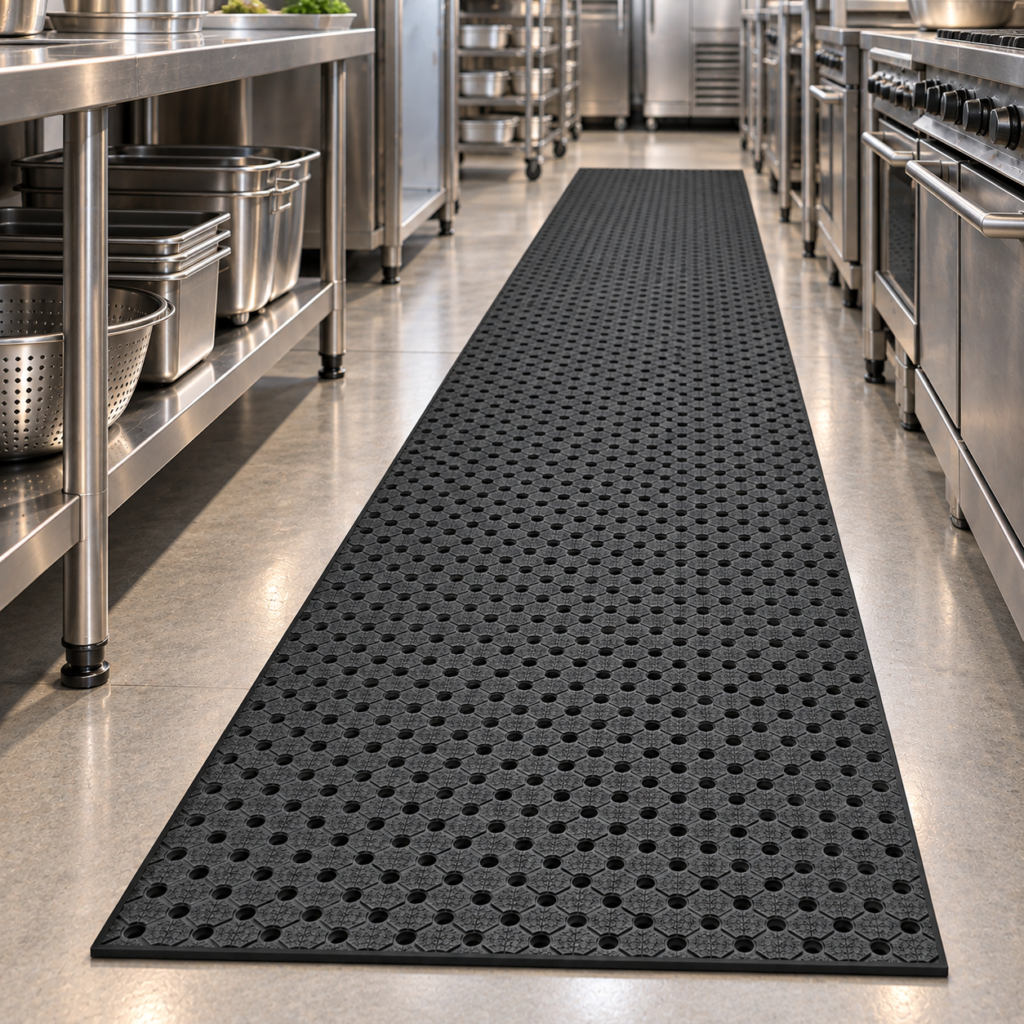
Anyone who cooks proper meals at home spends a surprising amount of time in the same two places: in front of the hob and at the sink. Hard kitchen floors are easy to mop, but they are tiring underfoot and unforgiving when water or oil lands on them. Well-chosen kitchen floor mats can make those standing spots more comfortable and give spills somewhere slightly more controlled to land. They will not make a glossy wet tile completely safe, and they are not a substitute for wiping up as you go.
This guide is for household kitchens and similar domestic utility spaces, not a commercial catering specification.
Where a kitchen mat actually earns its keep
You do not need to carpet the whole kitchen in rubber. Focus on the spots where you stand still:
- In front of the sink and dishwasher
- Along the main hob or range
- At a peninsula where you prep on the same spot every evening
- In front of a coffee machine or kettle if that is a long daily pause
A narrow runner that follows the worktop is often more useful than a small square that everyone steps around. Leave clear space around oven doors, dishwasher doors and pull-out bins so the mat cannot be rucked when something opens.
If you already use anti-fatigue mats at a standing desk or in a workshop, the same comfort idea applies in the kitchen, but the dirt is different: water, food residue, oil and the odd dropped utensil rather than swarf or concrete dust. Choose a surface you are willing to wash often.
Comfort, spills and grip
Comfort comes from a slight give underfoot, which encourages small movements in the legs and feels kinder than a rigid tile during a long cooking session. The mat should still feel stable. A surface that is too soft can make you feel as if you are standing on a sponge, which is tiring in a different way.
Spills are the kitchen test. A slightly textured or contoured surface helps contain a splash so it does not sheet instantly across the room. It should still be easy to wipe. Deep grooves that trap food are a hygiene nuisance. After any oily spill, clean the mat as well as the floor around it; leftover oil on either surface is a slip risk.
Grip works in two directions. The top should give a more secure footing than wet smooth vinyl or porcelain when it is damp — without any promise that nobody can slip. The underside should stay put on your particular floor. A mat that creeps as you work becomes a trip.
Compare household kitchen options with anti fatigue rubber mats if you want more cushioning for long spells of standing, and check that the product is suitable for a food preparation area you will clean with ordinary kitchen products.
Choosing a size and thickness
Measure the standing zone, then watch how you move while you cook. Most people step sideways along a run of units. A mat that covers two or three of those sidesteps is more helpful than one that only fits under a single pair of feet.
Keep thickness modest at any point where a door swings or where someone might catch a toe, including at the edge of a galley kitchen. A gentle edge profile is safer than a sharp lip. If you have underfloor heating, check the product guidance; some mats are fine as a loose overlay and others are not intended for that situation.
Colour is practical, not decorative. A very dark mat hides dirt until it becomes a greasy film. A slightly mottled surface shows when it needs washing without looking permanently stained.
Fitting so the mat stays put
Most home kitchen mats are loose-laid. That is useful, because you should lift them to clean beneath. On glossy porcelain or polished vinyl, look for a backing intended for hard floors, or a heavier mat that does not skate. Avoid general-purpose tapes that peel in the wet and leave adhesive on the tile.
Do not run a mat over a threshold strip or up against a cooker plinth so tightly that it ramps or buckles. Cut or choose a size that lies flat. If you have a textured slate or deeply grouted floor, test that the underside does not rock.
Near the back door, think of the kitchen mat and the entrance as a pair. Wet leaves often arrive from outside before they reach the sink run. A separate set of rubber entrance mats at the door will do more to keep grit out of the kitchen than asking one hob-side mat to do every job.
Cleaning and hygiene
Treat the mat as another worktop-level surface:
- Wipe crumbs and spills as they happen, especially anything oily or sugary.
- Wash with warm water and a little washing-up liquid or a kitchen cleaner the mat maker accepts.
- Rinse or wipe away residue so the surface does not stay slick.
- Dry the mat, or at least let it drain, before you step back onto it in socks.
- Lift it regularly and clean the floor underneath. Trapped moisture and crumbs are what start to smell.
Avoid abrasive pads and strong solvents unless the manufacturer says they are suitable. If the kitchen is also used by pets, pick up any accidents promptly; rubber is washable, but residue left in a texture is unpleasant.
Similar anti-fatigue mats used in other standing jobs follow the same cleaning logic: remove grit first, wash mildly, dry before reuse.
When not to use one
Skip a thick kitchen mat if it blocks a door, covers a floor vent you rely on, or creates a step at the only path through a small galley. Do not use a stained workshop offcut that might carry oil or chemicals into a food space.
If someone in the household uses a walking frame or wheelchair, any added edge needs extra thought. A flush, firmly seated mat may be acceptable; a loose, curling one is not.
Common mistakes
- Buying a tiny mat that nobody actually stands on
- Leaving an oily film because the dark colour "still looks clean"
- Using a deep industrial scraper surface that is miserable to wipe after cooking
- Never lifting the mat, then blaming the floor for a musty smell
- Expecting a mat to replace prompt spill clean-up
A kitchen mat is a comfort and housekeeping tool for the places you stand still. Size it to the way you cook, choose a washable texture, keep it flat and clean, and let a proper door mat — including rubber entrance mats if that suits your threshold — stop the garden arriving at the hob.