

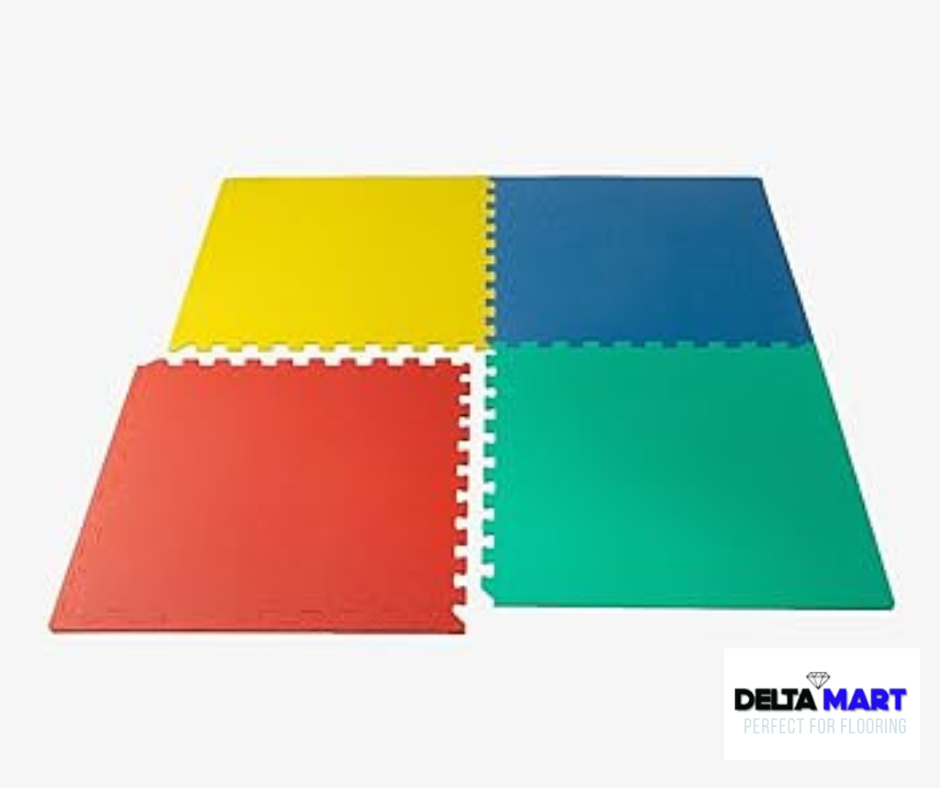
Rainy afternoons, younger siblings and early crawling all push play back indoors. A defined corner with foam tiles gives children a warmer, slightly cushioned place to sit and build, and it protects the floor from toys and snack debris. Parents comparing childrens play mats foam products usually want something that clicks together, wipes clean and packs away. That is a fair brief, as long as the foam is treated as indoor play comfort rather than as safety surfacing for climbs and jumps.
This guide is for household play corners. Foam tiles are not a substitute for independently assessed playground surfacing, and they are not automatically suitable outside through a UK winter.
What foam tiles do well
Interlocking EVA-style foam is light, warm to sit on and easy to rearrange. It takes the chill off timber or tile and reduces the clatter of wooden blocks. It also gives you a visual boundary: play stays on the colourful square, and the rest of the sitting room can remain a sitting room.
What it does not do is turn a sofa, bunk bed or indoor climbing triangle into a certified play structure. Falls from height, hard furniture corners and glass tables need separate thinking — moving furniture, using corner covers, and supervising — not a thin foam square placed afterwards as an afterthought.
If you also keep weights or do floor exercise in the same room, keep play foam separate from denser home gym mats. Children should not play on a dusty lifting area, and a kettlebell should not live on a foam tile that will punch through.
How much floor to cover
Cover the area where children actually sit, crawl and tip out the toy basket, plus a border so a rolling car or a toppling block stays on the foam. You rarely need the entire room.
Measure the corner, including the swing of any doors and the space in front of radiators. Leave heaters clear. Draw a simple grid using the tile size printed on the product you intend to buy; sizes vary.
An L-shape around a sofa can work if the sofa is the viewing seat for adults. A rectangle in an unused alcove is easier to keep tidy. Avoid placing the only play space in a draught at an external door or in a dark hallway where people carry kettles and laundry.
Other eva foam floor mats are useful if you want extra tiles in a matching thickness so the corner can grow as the toy collection grows.
Fitting and edges
Let new tiles sit in the room for a while if they have been compressed in a box. Click joints fully so they do not separate and pinch fingers. Keep cut pieces against walls rather than in the middle of the crawling path.
Edges matter. A thick foam step in the middle of a room can trip adults, especially at night. Dedicated border pieces, if offered, tidy the change of level. Without them, place the field against two walls so there are fewer open edges, or choose a location where the edge is obvious.
Do not run foam under a door that needs to close, and do not cover a floor vent.
A few denser gym mats nearby can be useful for adult stretching after the children are in bed, but store them separately if they are too heavy or too firm for the play corner itself.
Cleaning, spills and hygiene
Snack time will happen on the mats, however firm your rules are.
- Wipe spills promptly with a damp cloth and a little mild soap
- Avoid soaking foam; water that gets into damaged edges is slow to dry
- Let tiles dry before you click them back together after a proper wash
- Check joins for crumbs and small toy parts
- Retire a tile that is torn, bitten through or no longer stays clicked
Some foam has a slight new smell. Unpack and air the tiles before a baby spends long periods lying on them. Do not use strong solvent cleaners unless the manufacturer says they are suitable.
Pets add hair and the occasional accident. If a tile cannot be cleaned properly, replace it; foam is cheap compared with the alternative.
Similar interlocking foam gym mats used for light exercise should be cleaned before they return to a play role, and preferably not shared between sweaty workouts and toddlers.
Storage and changing the room back
One reason foam works in a spare room or living room is that it can come apart. Stack tiles loosely so they can dry and keep their shape. A crate or a big bag in a cupboard is enough.
If the room becomes a guest room, take the field up rather than pushing a folding bed over it. Wheels and metal feet punch foam easily.
When children outgrow floor play, the same tiles sometimes move to a dressing-up corner or get reused as temporary home gym mats for gentle yoga. By then you may want a firmer rubber surface for anything more vigorous.
Limits: outdoors, jumps and mixed ages
Do not treat indoor foam as garden surfacing. UV, rain and dirt break it down, and a wet foam tile is unpleasant and potentially slick. Bring outdoor dirt off at the door before children come back onto the play corner.
For older children who jump from furniture, the answer is to change the behaviour and the furniture layout, not to add another layer of foam and hope. Mixed-age families may need a firmer edge so toddlers are not sharing a bouncy block pit with bigger cousins wrecking the joints.
Common mistakes
- Using play foam as fall protection under indoor climbing equipment
- Leaving a trip edge on a busy path to the kitchen
- Soaking tiles and stacking them wet
- Mixing heavy gym equipment and toddler play on the same squares
- Covering the whole sitting room and then resenting it
A foam play corner works when it is a defined, wipeable, indoor sitting space with safe edges and honest limits. Cover the real play zone, click the tiles fully, clean spills promptly, and keep climbs, weather and heavy weights out of that square.